
Mark Lumsden: Pop-Up Data Centre

A project for the analysis of personal artifacts and social objects in a shifting data centered world. UoR MA Fine Art final show proposal.

  Home  |   Proposal  |   Statement  |   Course Work  

<< back     |     Joint Work 1

Time Frame: Oct 2025

This activity involved working with different members of the MA Cohort over a three week period. Initally, students were paired up. Each student was asked to create instructions and then give these instructions to their partner, who in turn, had to respond to their partners instructions (translating them into an artwork) and bring their response back to the art building a week later. The output(s) of the instructions were discussed collectively then each output was given to a different student, who was to take this work away and respond to it during the course of the following week. These outputs were then brought to art building one week later, curated in the studio space and discussed. These works were once again given to a different student to respond to. One week later these 'final' artworks were brought to the art building and curated by 2 individuals and collectively discussed.

The activity was interesting in different ways:

Below are my list of instructions for my selected partner (Yujie) in the first week activity . I wanted the instructions to include some element of 'randomness', so as to lead the person who got them to somewhere I/they hadn't expected. This was randomness idea was influenced by John Cage.

  1. Visit https://www.random.org/
  2. In the "True Random Number Generator" form (see red box below), fill in '1' as the min value and '999'* as the max value. Click 'Generate'.
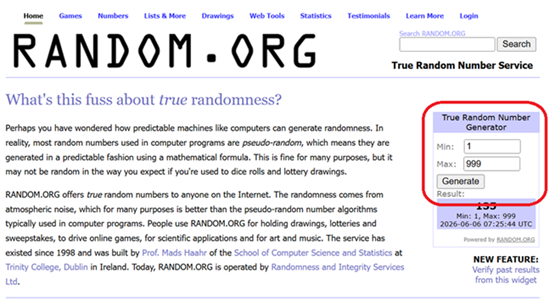
      Screenshot of random.org. Random number generator to the right.

  3. Using the random number generated in the previous step, go to the library and find the shelves which have books with the same number under the Dewey Decimal class system.
  4. Count the number of books in that class.
  5. Put '1' in the 'Min' box of the Random Number Generator and the total number of books you counted into the 'Max' box. Click 'Generate'.
  6. Using the newly generated number, select the book which is that number from the lowest numbered book in that class.
  7. Using the book you have selected, fill in the Number Generator form with the lowest page and highest page number of the book in 'Min' and 'Max' boxes repectively. Click Generate.
  8. Using the newly generated number, open the book at that page. If the page is blank, run the number generator again, until you select a non-blank page.
  9. Use the text from this page to derive an artwork.

* 999 is the highest number in the Dewey Decimal Classification (DDC) system.

Unfortunately, on the day of the excercise, I forgot to bring the printed version of the instructions to Reading so I hurriedly wrote them on an A4 piece of lined paper. My handwriting isn't very legible (to others) so Yujie asked me for help in understanding them. We both went to the library and started generating numbers and following the process above and ultimately ended up in book about the chemistry of making paint! [Note I have asked Yujie for a photo of what she created from my instructions - hopefully she will be ok with sending me something and I will add it here.]


I was paired with Caitlan Croft and on week one received her instructions. Caitlan provided hand-written text on A4 paper from a sketch book.
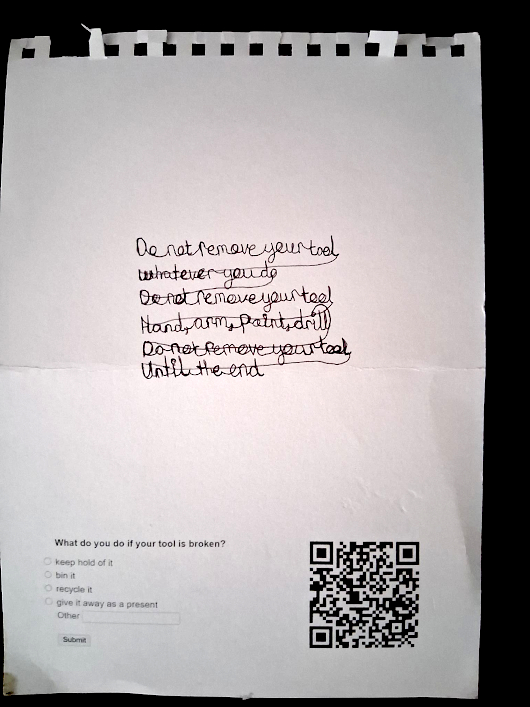
  Pen on A4 paper by Caitlan Croft.
  Printed question and QR code by Mark Lumsden
  Oct 2025.

I felt Caitan's piece of writing was about loyalty, almost undying loyalty. My response to her text was a question and QR code printed on the same piece of paper which she had written her text on. For me the natural response is to ask the question, how far should loyalty go? Would you use a drill without a bit? Would you use paint if it had dried and was unusable as a medium to mix and spread over a surface? Of course, depending on what you are doing, the answer could be 'yes' or 'no' to these 2 questions, but if you trying to drill a 2mm hole without a drill bit, you may find the going a bit tough.

Although Caitlan's writing includes inanimate objects, I felt loyalty in this writing is easily extendable to animate objects (i.e. people) and was possibly being being used in this manner by Caitlan already. Either way, for inanimate objects or people I think the question: 'What do you do if your tool is broken?' is still legitimate. Shouldn't we question loyalty?

The QR code still works and the question is part of my other work 'Online Questionnaire: Fun Questions'. The question is number 35


This activity seemed like an stepping stone to the following 'joint' activity: 'Laocoön and His Sons'. Which would bring its own challenges.